

The Three Intelligences: A Response to a World in Uncertainty

We live in times of radical uncertainty. If in the past we spoke of a VUCA world (volatile, uncertain, complex, and ambiguous), today we face head-on a BANI environment:
Brittle
Anxious
Nonlinear
Incomprehensible
Technological acceleration, climate crises, and geopolitical volatility have led to a world where structures once considered stable can suddenly collapse. Information overload and widespread anxiety further complicate decision-making. So, how do we navigate this chaos without losing direction?
At catalytic-A, we believe that "the three intelligences" are a response to a world in uncertainty. It's not just about technology or just about human skills: the real differentiator lies in the ability to integrate different levels of intelligence to innovate and generate impact.
The Three Intelligences Model: A Response to a World in Uncertainty
To design solutions that not only survive but thrive in an environment of high uncertainty, it's necessary to develop three types of intelligence simultaneously:
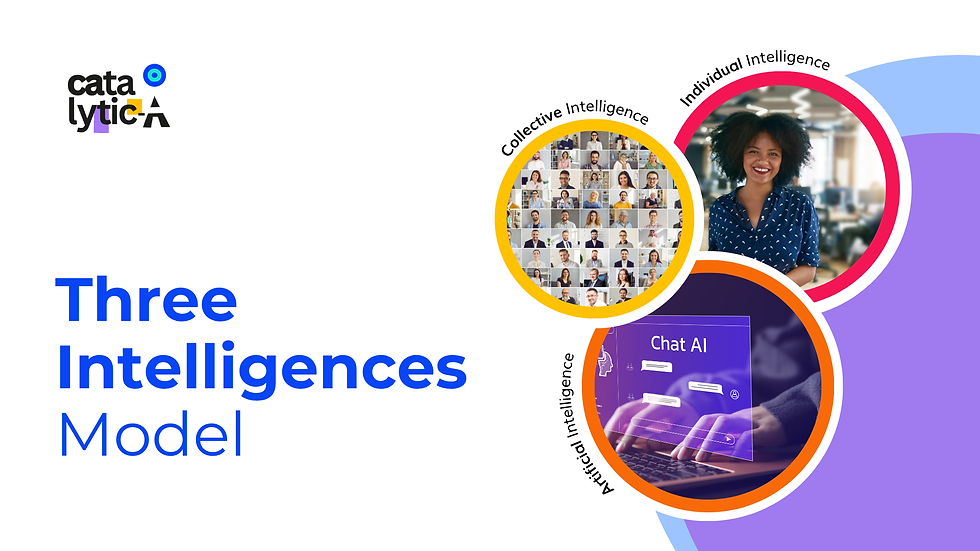
🔷 Individual Intelligence: Human Skills for Success
The first pillar is individual intelligence, understood as each person's capacity to navigate uncertainty with leadership, resilience, creativity, and critical thinking.
It's crucial to learn to control our emotions, not act from insecurity or fear, and trust in our abilities and judgment. These are fundamental aspects for dealing with the anxiety and stress of the context we face.
At catalytic-A, we've rebranded soft skills as success skills, because that's precisely what they are: human skills responsible for 85% of a person's professional success, according to studies from Harvard University, Carnegie Foundation, and Stanford Research Center. In a BANI world, where anxiety and information overload are constant, knowing how to manage emotions, lead with empathy, and communicate effectively is a key differentiator.
What does this intelligence protect?
Individual Intelligence ensures that people are not merely "informants" or passive executors, but actors with their own judgment. It protects against the trap of extractive participation, where people are consulted only to validate decisions already made, and ensures that each actor can contribute from their experience and situated knowledge.
It also ensures that artificial intelligence doesn't replace human judgment in decisions requiring context, ethics, and sensitivity. And it prevents collective spaces from becoming empty meetings where no one feels genuinely heard.
💡 Actions to implement: Prioritize training in transformational leadership, change management, or strategic thinking as part of a company's human talent management strategy. These are not "complementary" skills: they are the foundation upon which everything else is built.
🔷 Collective Intelligence: The Power of Connection
We're moving from an era of specialized solutions to one of multidisciplinary solutions. In this complex world, marked by interdependence, challenges must be addressed from all dimensions, and only through different perspectives can we articulate disruptive solutions with structural-level impact.
Beyond this paradigm shift, we also see a transformation driven by technological advances, moving now to a scheme where digital interactions predominate.
In this new context, human collaboration is and remains our greatest competitive advantage.
Collective intelligence, understood as a group's capacity to solve problems, generate ideas, and build knowledge together, is the key to generating innovative solutions with a multidimensional vision.
What does this intelligence protect?
Collective Intelligence ensures that solutions emerge from the reality of those who operate the system, not just from external technical design. One of the greatest predictors of failure in development projects is the lack of social license: when decisions feel imposed "from above" or "from the consultant," resistance is inevitable.
Collective Intelligence operates exactly the opposite way. It's not about "consulting" stakeholders to validate a pre-designed solution. It's about co-creating with them, particularly taking into account the voice of the target audience, so that the final result is something they recognize as their own.
This has a direct effect on adoption. When a diverse group of actors builds together a theory of change, a governance model, or a financing strategy, they don't need someone else to convince them to implement it. They themselves become its promoters.
What is the challenge?
The challenge is to re-value connection, in-person interaction, co-creation, and building memorable experiences, while combining these experiences with digitally-facilitated collaboration. Human contact, face-to-face conversations, and group dynamics, in addition to systematizing learning, not only generate innovation but strengthen trust and creativity.
💡 Actions to implement: Redesign workspaces to enhance in-person collaborative work and methodologies to foster collaboration in virtual environments, recognizing that the best ideas emerge in spontaneous interactions and environments that promote co-creation.
🔷 Artificial Intelligence: Amplifying Human Capacity
Far from replacing us, artificial intelligence is here to amplify our potential.
But first, let's better understand what artificial intelligence is. AI is not a single technology, but a set of techniques, algorithms, and approaches that include machine learning, natural language processing (NLP), computer vision, robotics, and other components. These elements work in synergy to create systems capable of performing complex cognitive tasks, analyzing data, learning from it, and making predictions or decisions without being explicitly programmed for each task.
When used correctly, it can become a tool that allows us to explore new spaces of our own intelligence. A path that has been built since the first computer processors and has managed to break limits in terms of information processing.
What does this intelligence protect?
Artificial Intelligence ensures that systematization doesn't lose its human meaning. It organizes and scales what people and groups have built, but it doesn't invent it from scratch, nor should it invent or infer it.
A fundamental principle operates here: AI enters when there's already meaning. First come human conversations, collective agreements, co-created ideas. Then, AI helps organize them, compare them against quality criteria, systematize them so they can be reused, and maintain coherence when multiple actors are involved.
The trap is using AI to "accelerate" without having gone through the necessary human processes. The result is technically impeccable documents that no one recognizes as their own.
What is its true potential?
It's very important that we give it direction and that responsibility and ethics are at the center of its development and use.
Artificial intelligence is a catalyst for innovation when we know how to integrate it strategically into our work. Its true power doesn't lie in its ability to automate tasks, but in its use as a tool that enhances decision-making, data analysis, and gives us the tools and resources to enhance our creativity.
💡 Actions to implement: Develop internal capabilities to use AI strategically—not just operationally—recognizing that its greatest value lies in amplifying human judgment, not replacing it. This implies training, responsible experimentation, and ethical clarity about where to use these tools and where not to.
Integration: Why All Three Together
The Three Intelligences model is not sequential. It's not "first we train people, then we hold workshops, and finally we systematize with AI." It's systemic.
Each intelligence protects something the others cannot:
Individual ensures that people are not objects of the process, but subjects with judgment.
Collective ensures that solutions have legitimacy and emerge from the reality of the system.
Artificial ensures that what's built remains coherent, gets systematized, and can scale.
When one is missing, the system weakens:
Without Individual, projects become technical processes without human ownership.
Without Collective, solutions come "from above" and face resistance.
Without Artificial, learnings remain anecdotal and each project starts from zero.
The magic lies in combining them consciously, recognizing that in contexts of high uncertainty, being good at just one dimension isn't enough. The future belongs to those who can integrate the human, the collective, and the technological fluidly.
An Invitation to Rethink
In a BANI world, old recipes no longer work. We can't solve complex problems with just more technical expertise, nor just more participation, nor just more technology. The three intelligences are a response to a world in uncertainty that demands new ways of thinking and acting.
We need all three intelligences working together.
How is your organization addressing uncertainty? Are you developing the three intelligences in a balanced way, or is one being neglected?
The answer to that question may be the difference between surviving chaos and thriving in it.

Comments